
By Josh Ayen | Originally published by WANE 15 (Apr. 23–24, 2026)
COLUMBIA CITY, Ind. — Leonard “Feets” Barnum wasn’t just a football player—he was a cornerstone of the Columbia City community.
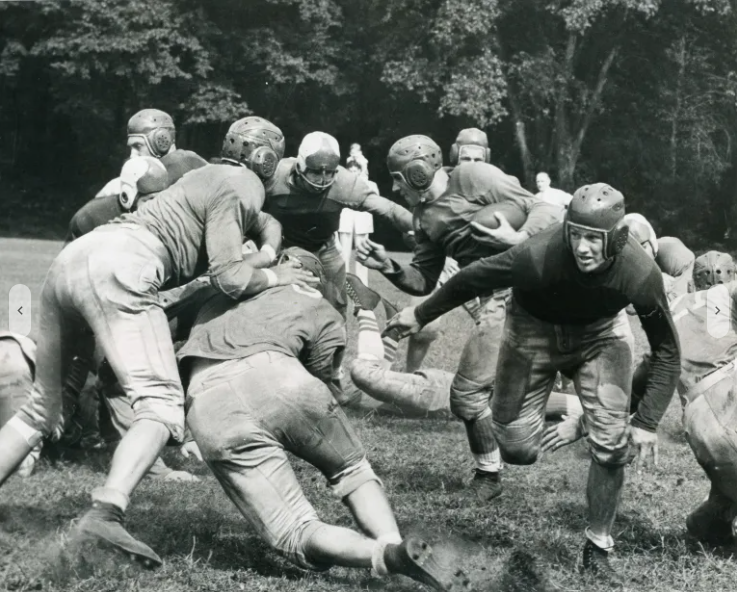
“He was a hero to me,” said his youngest son, Stephen Barnum. “He was a hero to many people he lived with, worked with, and taught. I always looked up to him.”
Barnum’s life was defined by service—as a camp counselor, coach, mentor, and friend. But before becoming a community fixture in Columbia City, he made his mark on the football field in a way few others can claim.
Born in 1912 in Parkersburg, West Virginia, Barnum excelled as a multi-sport athlete in high school, competing in football, basketball, and track. He went on to play college football at West Virginia Wesleyan, where his versatility stood out. In an era when players rarely specialized, Barnum did it all—running, passing, and playing defense.
In 1936, the National Football League held its very first draft. With the 12th overall pick, Barnum was selected by the Pittsburgh Pirates (now the Steelers), becoming the first quarterback ever drafted in NFL history.
Though he didn’t immediately join the Pirates—choosing instead to coach high school football—Barnum eventually entered the league with the New York Giants. There, he showcased his all-around ability as a passer, punter, and kicker. He helped lead the Giants to an NFL Championship victory over the Green Bay Packers, winning 23–17.
Barnum later played with the Philadelphia Eagles from 1940 to 1942, finishing a five-year NFL career that included 590 rushing yards, 602 passing yards, and a strong punting average of 41.8 yards.
While the modern game emphasizes passing and specialization, Barnum’s era required adaptability and toughness. His story serves as a reminder of how much the game—and the role of the quarterback—has evolved.
“We get caught up in the modern game,” said local historian Mark Parker. “We don’t always look back at how the game progressed or recognize the quality players from earlier eras.”
But for those who knew him, Barnum’s greatest legacy wasn’t on the field.
“You’re not going to put him in the Hall of Fame for football,” Stephen said, “but you can put him in the Hall of Fame for people.”
Barnum passed away in 1998, but his impact continues to be felt across Columbia City. The athletic complex at Indian Springs Middle School bears his name, and artifacts from his career are preserved at the Whitley County Historical Museum.