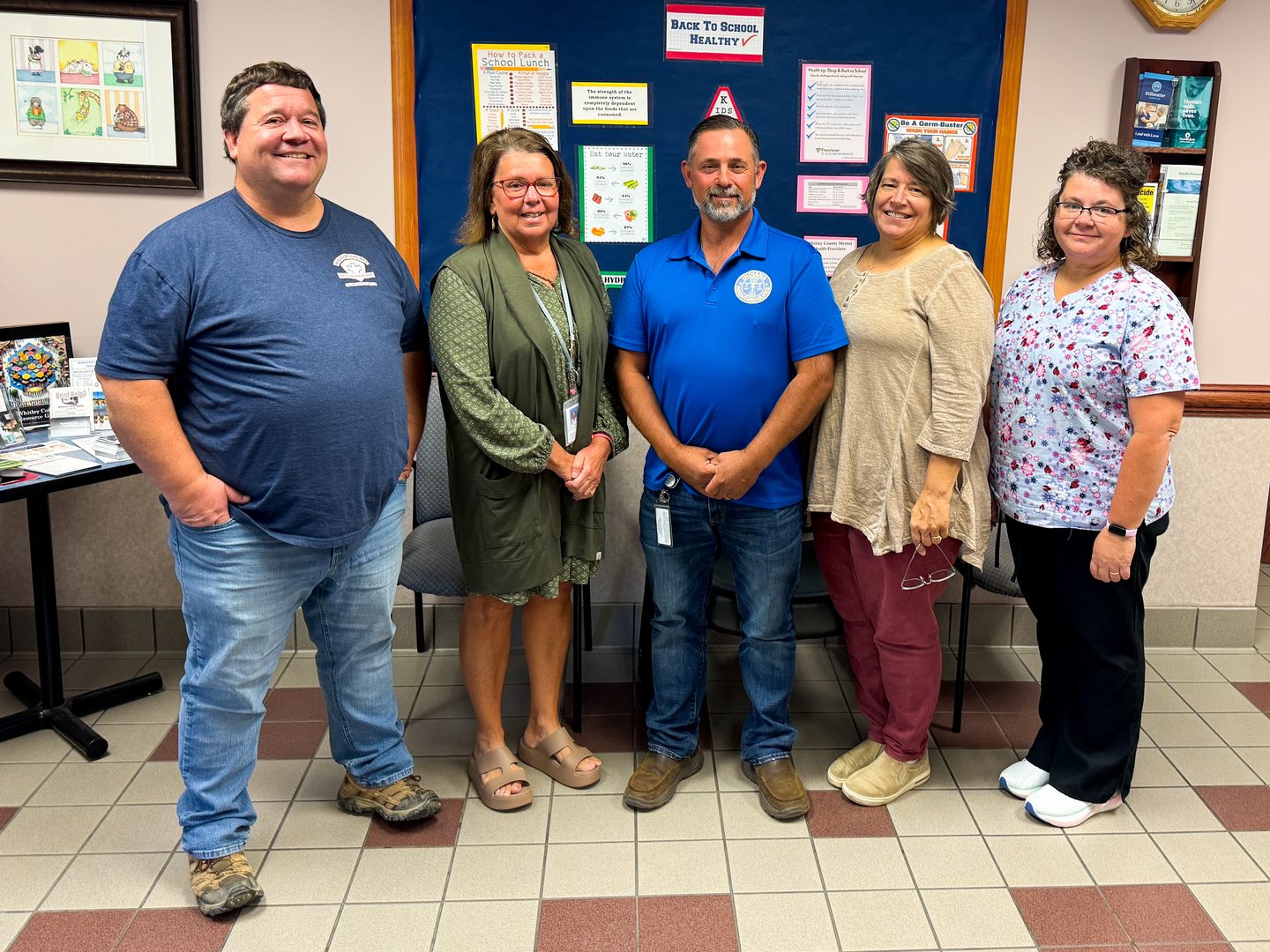
When most people think about the Whitley County Health Department, immunizations may be one of the first things that come to mind. But the work happening inside the health department goes far beyond vaccines.
Established in 1957, the Whitley County Health Department has grown into a 10-person team working across public health, environmental health, food safety, community education, prevention, resource connections and more. Scott Wagner, director of the Whitley County Health Department, has been with the department since 1996 and has served as director since 2016. He says one of the biggest misconceptions about the health department is just how many different things happen there.
“We do quite a lot of different things.” Wagner said.
The department includes three full-time nurses, a food inspector, environmental inspector, lactation consultant, weights and measures inspector, immunization clerk and vital records staff, along with Wagner and the department’s health officer, Dr. Burkett.
That means the department may be involved with everything from restaurant inspections and food safety to septic systems, pools, tattoo establishments, lodging, lead exposure, communicable diseases, immunizations, birth and death certificates, and environmental complaints. But increasingly, the department is also becoming a place where people can turn when they simply don’t know where else to go.
Finding the Gaps
That is where Community Health Nurse Darcy Hoopingarner comes in. After retiring from Parkview as a nurse practitioner, Hoopingarner joined the health department and describes her role as an “open book.”
“I really felt like Scott gave me kind of an open book. I could do what I wanted to do with the position,” she said.
So she started looking for gaps and areas of concern in the community. Her work now stretches across a wide range of programs and partnerships. She works with eight different senior groups each month, participates in community events, writes grants, serves on boards and helps connect residents with resources.
One of the programs she is especially passionate about is Women’s Wellness, a monthly gathering designed to give women an opportunity to learn, ask questions and connect. The program began at the library before moving to the Council on Aging, where the larger space allows 30 to 40 women to attend each month. The topics have ranged from cardiology, weight management and integrative medicine to personal safety, social media scams, mindfulness, mental wellness, grief, financial health and more. Speakers have included physicians and other professionals who give attendees an opportunity to ask the questions they may not have time to ask during a typical appointment.
“Many of your speakers are physicians,” Wagner said. “How often do you get to go in and talk to your physician for an hour and a half? You don’t. You get seen for 15 minutes.”
But Hoopingarner says the value of Women’s Wellness extends beyond the information presented. It has become a place where women are making connections with one another.
At one meeting focused on mindfulness and mental wellness, one woman shared that she had lost her spouse and was attending grief counseling in Fort Wayne. Before the evening was over, she had connected with another woman who was also going through grief, and the two planned to carpool to counseling together. At another meeting, women participating through work release joined the group. They had learned to sew and made projects to give to the other women attending.
For Hoopingarner, watching the women share their stories and spend time together was one of the most meaningful parts of the program.
“These are little things. They might seem little, but they’re big wins in my book,” she said.
Women’s Wellness meets on the fourth Tuesday of each month from 6 to 7:30 p.m. at the Council on Aging. It is free, and no registration is required.
Building a Network of Resources
Hoopingarner also describes herself as a “resource funnel.”
The health department has been building a growing resource guide with information about food pantries, clothing, childcare, financial assistance, healthcare, housing and other services available locally and regionally. The goal is to make the health department a place where residents can start when they aren’t sure where to turn.
“There is no reason any individual should have to go without,” Hoopingarner said. “We have so many amazing organizations and resources, if we just get them connected.”
The department is currently working toward developing a more formal resource center, potentially including a part-time navigator who could help residents identify resources and figure out how to access them. The need for that kind of connection is something the department sees regularly.
“We’re trying to become that one spot where everybody knows, ‘Oh, you just go to the health department,’” Wagner said.
The department’s resource list is already about 30 pages long and continues to grow. The long-term goal is to make the information easier to access online, while still providing a person who can help residents navigate the information when a website or list isn’t enough. Sometimes connecting someone with a resource is as simple as providing a phone number. Other times, it means helping someone figure out transportation, healthcare, childcare, housing or another barrier.
The department’s philosophy is simple: connect people with the organizations already doing the work in the community.
Filling Gaps Through Partnerships
Many of the department’s programs have developed because someone noticed a gap and decided to find a way to fill it. When the local birthing center closed, for example, the department identified women and children’s health as one of its priorities. That led to new efforts around car seat safety. Immunization nurse, April Waugh, became a certified car seat technician, and Hoopingarner later became certified as well so the department could serve as a Car Seat Fitting Station and hub.
The department has also expanded its CPR education. Hoopingarner and Waugh are among the department’s CPR instructors, along with Emily Banks, an American Heart Association Community Connector. The team teaches CPR throughout the community, including hands-only CPR to students. Hoopingarner and Waugh also teach QPR, a suicide prevention training program, and are preparing to offer fall-prevention training through a partnership with Parkview.
The department has also built stronger relationships with individuals involved in work release and the correctional system. Waugh became a peer recovery coach and works with those individuals on programs such as gardening and sewing, while the health department provides education and connections to resources. The goal is to make sure those relationships don’t end when someone leaves the program.
“We develop a relationship with those individuals, so they know when they’re released, if they need something, they can come here,” Hoopingarner said.
Bringing Resources Together
The department’s partnership work was especially visible at the Whitley County Resource Fair held this summer at Indian Springs Middle School. More than 1,000 people attended the event, which included more than 100 vendors and organizations. The numbers tell part of the story: 550 lunches were served, 762 backpacks filled with school supplies were distributed, more than 160 haircuts were provided to school-age children, and 104 sports physicals were completed. Healthcare providers also offered dental, hearing and cardiac services. Hoopingarner helped connect the event with healthcare providers, including IU School of Dentistry and Riley Pediatric Cardiology.
For Hoopingarner, the success of the event was about more than the number of people who walked through the doors. It was about bringing services that people may not otherwise know how to access directly into one place. The health department has continued building that same network through other partnerships, including organizations that provide transportation, healthcare, social services and other forms of assistance.
Continuing to Evolve
The health department that exists today looks very different from the one that opened in 1957. Wagner says that is because public health has to change with the needs of the community.
“You just have to be open-minded to evolve,” he said.
As some responsibilities change, the department looks for new ways to use its staff and resources. When fewer families began using the health department for childhood vaccinations because pediatric offices were offering the same services, for example, Waugh expanded her role into peer recovery work and other community programs. That willingness to adapt has become part of the department’s culture.
“You just gotta change with things,” Wagner said.
At the center of that work, however, is a simple idea: being a public servant.
“Everybody that works here is a public servant,” Wagner said. “They’re not here to be in charge or take ownership of something. They’re here to help the public as best we can.”
That may mean inspecting a restaurant, teaching CPR, helping someone find a car seat, answering a question about a community resource, connecting someone with healthcare or simply being the person who knows where to send someone next. And that may be the biggest thing to know about the Whitley County Health Department: you don’t have to know exactly what you need before you walk through the door. Sometimes, you just need to know where to start.
The Whitley County Health Department is located at 220 W Van Buren St #106.
Hours: Monday – Friday 8:00 AM – 4:30 PM
Connect with the Whitley County Health Department and other local organizations at the upcoming Health & Wellness Alley event at First Fridays on October 2 from 6:00 – 8:00 PM. Located in the alley between the Government Center and Reinholt’s Furniture & Mattresses.