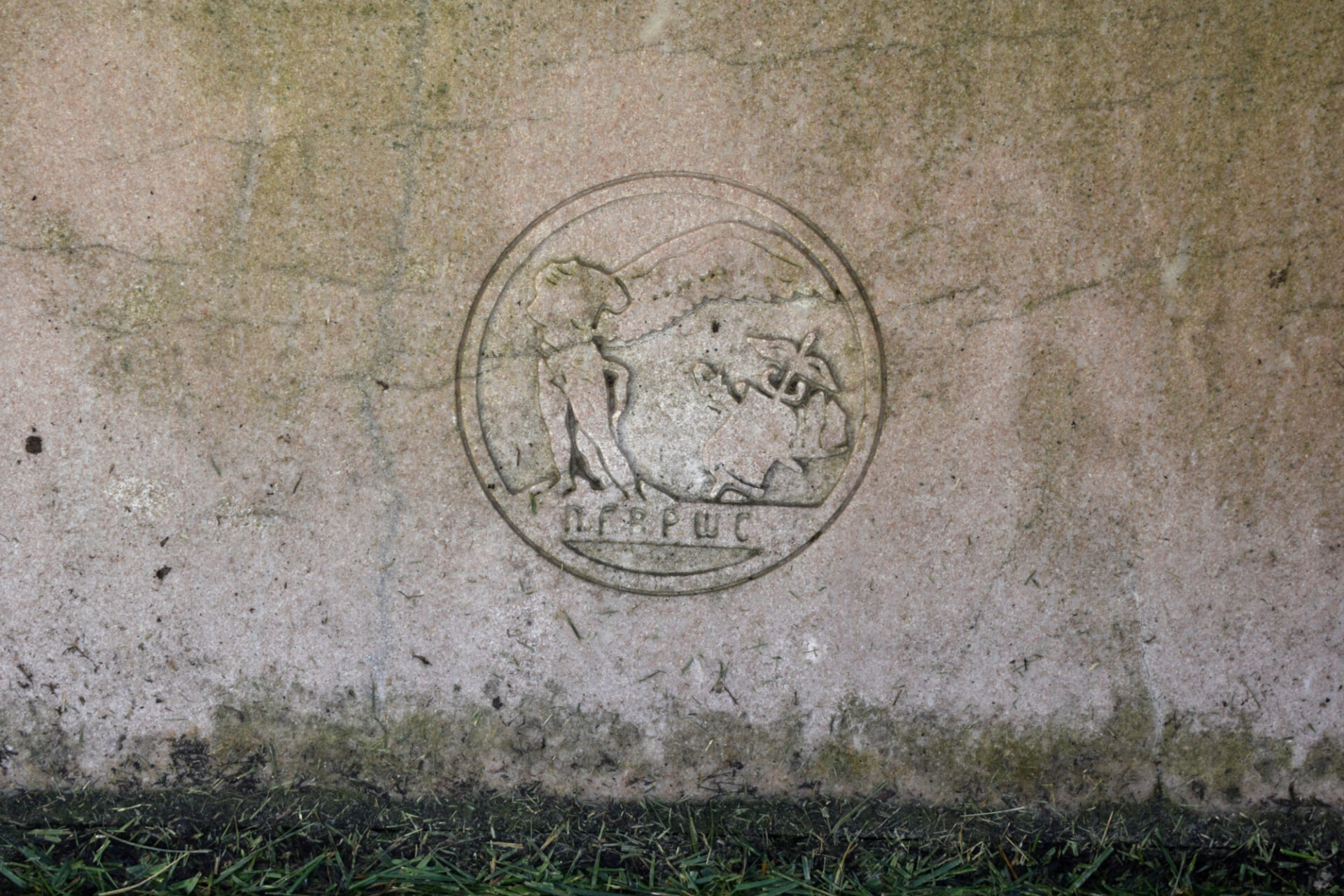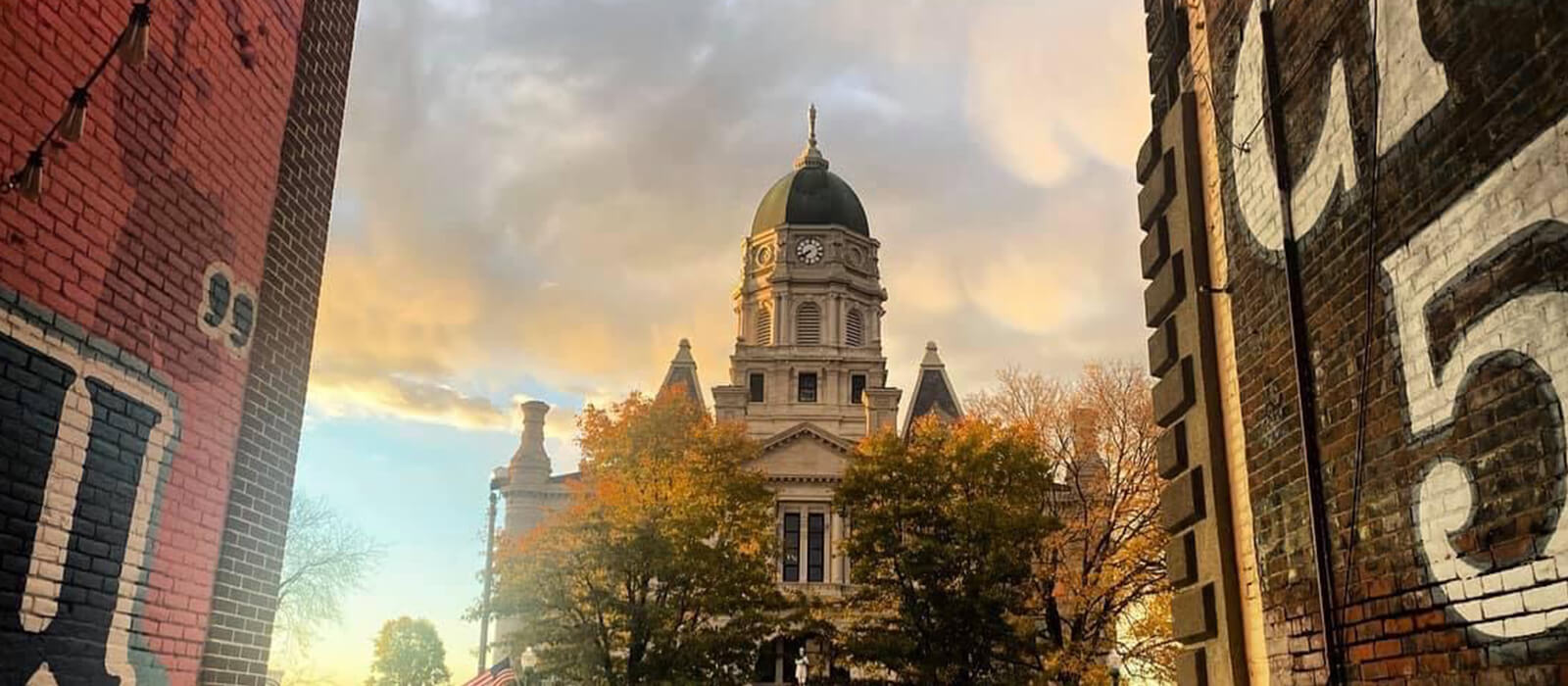
Baker Park is largely overshadowed today by the hustle and bustle of baseball and sledding at nearby DeVol Field or frenzied activities of children at the adjacent Every Kids’ Dreamland, But, once upon a time, Baker Park was a hub of community activity.
Named for John W. Baker, a primary feature of the park was a large pavilion that was available for use by the public. A look in the society pages of the local newspaper shows just how frequently the site was used to host family reunions, class reunions, club meetings, picnics, anniversary parties, weenie roasts and more, making it a place almost constantly in use. Because the pavilion was open on the sides, this limited use to the nicer months of the year, however people were using the space from early spring to late fall every year.
In 1962, an article in the Commercial Mail newspaper noted that the City Council had approved new fees for the Baker Park Pavilion. It would be available for $5 on Sunday afternoons until 6 p.m. The rest of the time, it was $2.50. Previously, it had been $2 on Sunday afternoons and 50 cents for all other times. It was advertised as being able to accommodate 70-80 people in the pavilion. The same article announced that a new pavilion would be opening in 1963 in Morsches Park, a move that likely turned the course on big events being hosted in Baker Park going forward.
With the growth of other parks in Columbia City, however, Baker Park has become more of a passageway than a true destination. The pavilion was showing its age and was torn down in the early 2000s, though a concrete pad still remains.
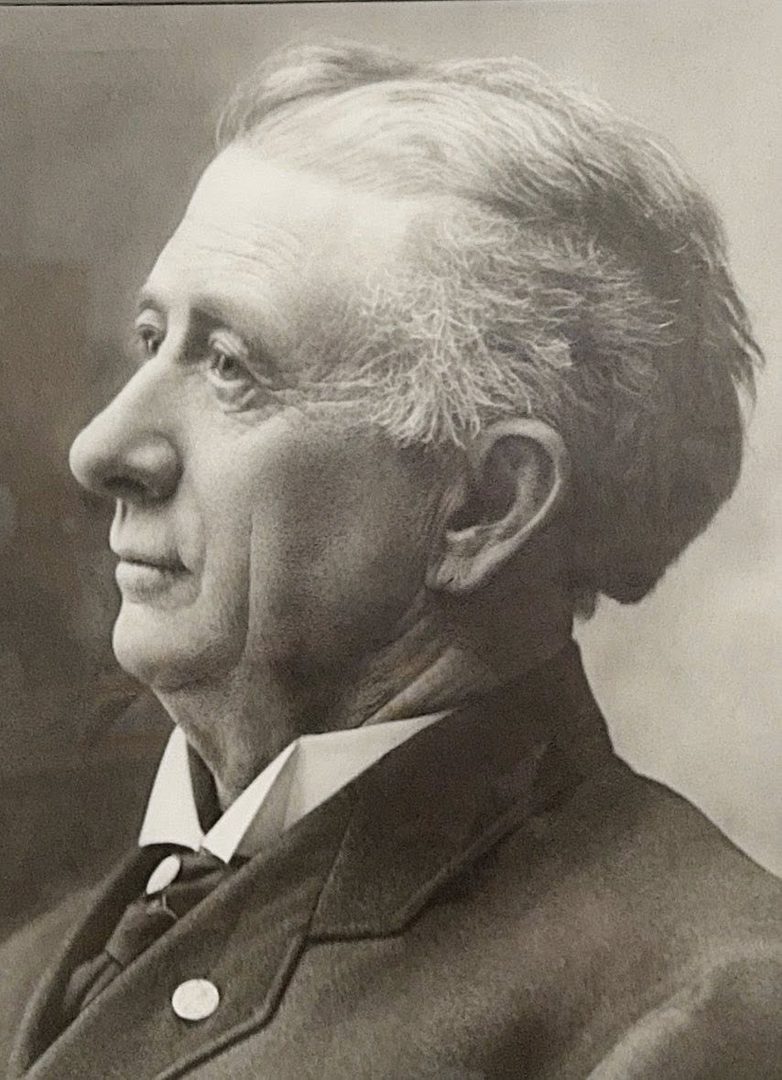
𝐉𝐨𝐡𝐧 𝐖. 𝐁𝐚𝐤𝐞𝐫
John Wesley Baker was an early resident of Columbia City, a former Mayor of Columbia City, postmaster, State Representative and editor of the local newspaper. He also attended Indiana’s first Republican State Convention in 1871 and is considered a founder of Old Settlers Days.
John Wesley Baker was born March 7, 1845, to Henry D. Baker and Eve (Switzer) Baker-Crawford in Ohio.
In 1850, the family was living in Big Lick, Hancock County, Indiana, and John was one of six children in the household. Henry Baker was a farmer.
By 1860, Henry had died and the family was living in Wayne Township, Kosciusko County, Indiana. John’s 20-year-old brother Jacob was the eldest child living at home with his widowed mother and worked as a harness maker. The other four children were in school, including 16-year-old John.
John’s first job was for a printing company, which would inspire his early interest in newspapers. In 1862, he secured a role with the Northern Indianian, a newspaper published in Warsaw.
On July 26, 1864, he married Sarah Elizabeth Thornburg in Kosciusko County. She was the daughter of Abraham Thornburg of Laporte County.
In late January of 1869, Baker, a resident of Warsaw, purchased the Columbia City Post newspaper and moved to Whitley County. He then transformed that publication into his own Republican-leaning The Commercial newspaper. He published the first edition on January 17, 1869, and continued publishing it weekly until September of 1888 when he launched the Daily Commercial and published both newspapers — a weekly and a daily — until January 9, 1905.
Of those times in the early days of his career, Baker would reflect, “In those days, to be an editor was to be a decided political partisan. Every editor, at one time or another in his career, had to decide whether to sacrifice the pen for the platform. In my case, politics were the important interest from the start.” Indeed, Baker would eventually give up his pen entirely for political aspirations.
In 1877, he was chosen by the Indiana Legislature to become a director of the state prison at Michigan City and remained on the prison’s board of directors for two and a half years.
In 1880, the Bakers were living in Columbia City with their children — Melvin (14), Grace Greenwood (9), Estella May (13) and five-month-old Carl Blaine Baker. Carl died young and the family lost track of Melvin after about 1911.
In 1884, he was appointed postmaster at Columbia City, a position he held for four years.
In 1892, the Fort Wayne Journal Gazette newspaper featured an editorial lauding the reputable John W. Baker, editor of The Commercial newspaper in Columbia City as a venerable candidate for Congress, painting his potential candidacy as a David and Goliath scenario. The editorial spoke highly of Baker, stating, “Many men in northern Indiana, who from small beginnings and obscurity, have become famous in law and politics, owe largely to John W. Baker the honors and emoluments they now enjoy, for it was his fearless and tireless little paper that brought their names before the public and it was John W. Baker and his paper who kept them there until they gained recognition, substantial in honors and emolument. Has fought the hard battles of his party for years, sometimes alone. He has never received or asked compensation for his services, and now, if there is any one man in the Twelfth District more deserving of honors than another; if a lifetime of hard work and loyalty to principles; if fighting so well and so long against such fearful odds is worthy of recognition and remembrance of his fellows, then John W. Baker will not be overlooked at the convention.”
Sadly, he lost the nomination for Indiana Lieutenant Governor by just 37 votes.
Two years later, his name was being floated for a Congressional run.
In 1898, Baker was elected and served one term in the Indiana House of Representatives representing Whitley and Kosciusko Counties. In early 1900, Baker was touring the state and floating his potential candidacy as Republican nominee for lieutenant governor, but by mid-March of that year, he did not seem to be catching the fire that two other Republican candidates were — Posey and N. W. Gilbert. Reports from the time indicated that Baker was really an underdog, but his dogged effort toward the nomination did gain him attention within his party. Gilbert was favored by the party for the Governor or Lieutenant Governor’s nomination, but he seemingly did take note of Baker’s service and voracity.
In 1900, the Bakers were still living on Van Buren Street in Columbia City as empty nesters. John was still editing the local newspaper in spite of an eye toward political endeavors.
In 1902, he sought the Republican nomination for joint senator of Whitley and Huntington Counties, but was defeated by Harmon M. Purviance, an undertaker, in securing the nomination. Of the loss, an editorial in the Journal Gazette read, “Mr. Baker has devoted his whole life to the service of the republican party without reward.” At that convention, Huntington had 21 votes and Whitley County had just 11.
In January of 1906, the Fort Wayne Journal Gazette reported that John W. Baker had been recently appointed postmaster in Columbia City. His brother, H. E. Baker, would serve as assistant postmaster. “Both John W. Baker and his brother are known in practically every home in Whitley County, and they assume their duties in office with the best wishes of hosts of friends in both political parties,” read the article.
“John W. Baker has heretofore sought political position, in which he has not always been successful, notably the lieutenant governorship and speaker of the house of representatives when he was a member of that body, largely due to lack of harmony in the Whitley County Republicanism. He was likewise disappointed in his aspirations to be made Columbia City’s postmaster eight years ago, but was defeated because the opposing faction was in charge of the county organization. Thus, his present appointment is a source of extreme gratification to himself and his friends.” He was officially installed in the office in February of 1902 for a four-year term, taking over for Col. Walter W. Williamson who had been the editor of a competing newspaper in Columbia City, The Mail. The Mail was Democratic leaning while The Commercial was Republican and over the years, a bitter feud had formed.
A year prior, Baker’s appointment to the postmaster was a decision made by then Congressman-elect N. W. Gilbert, a Republican, who replaced Williamson who had been in the role for eight years. Gilbert and Baker had been fierce political opponents in the Republican party many years prior while Baker and Williamson had been editorial opponents with competing newspapers. Ultimately, political favor won out.
“Mr. Gilbert’s decision to recommend one of his bitterest opponents grew out of a political exigency which, in turn, was the fruit of a war waged between rival newspapers for a dozen years,” read an article in the January 9, 1905, Journal Gazette. “Now both the political and journalistic warfare is over, it is announced, for Baker, in consideration of receiving the federal plum, agrees to retire from the newspaper field, leaving Mr. Williamson in sole possession as editor of The Mail. The announcement of the deal and the forthcoming suspension of The Commercial will be made either today or tomorrow in both The Mail and The Commercial.” As part of the deal, Baker was to suspend publication, sell the business at a reasonable price to Williamson, liquidate all of his presses and materials, hand over his subscription list to Williamson and agree not to establish another republican newspaper in Columbia City for at least 10 years. Also, as part of the deal, Baker’s brother was to be employed by The Mail newspaper for one year before transitioning into the assistant postmaster position. For agreeing to step aside from the postmaster’s role, he would be given a monopoly on the newspapering in Columbia City.
For the Baker family, this was a good deal. Each four-year term as postmaster paid $2200 per year for the postmaster and $1100 per year for the assistant postmaster. In today’s terms, that would be a salary of about $80,000 for Baker and $40,000 for his brother, and the potential to name other family or friends into other clerk positions within the post office.
Four years later, in 1910, he was reappointed again to the Postmaster position with a $100 per year increase in salary.
In 1906, Baker purchased a five-acre parcel of land on McDonald Hill on the west side of Columbia City. The parcel was purchased from Colonel I. B. McDonald. At the time of the purchase, Baker planned to build a new residence on the lot and fashion a large portion of the property into “a poultry park for raising fine fowls.”
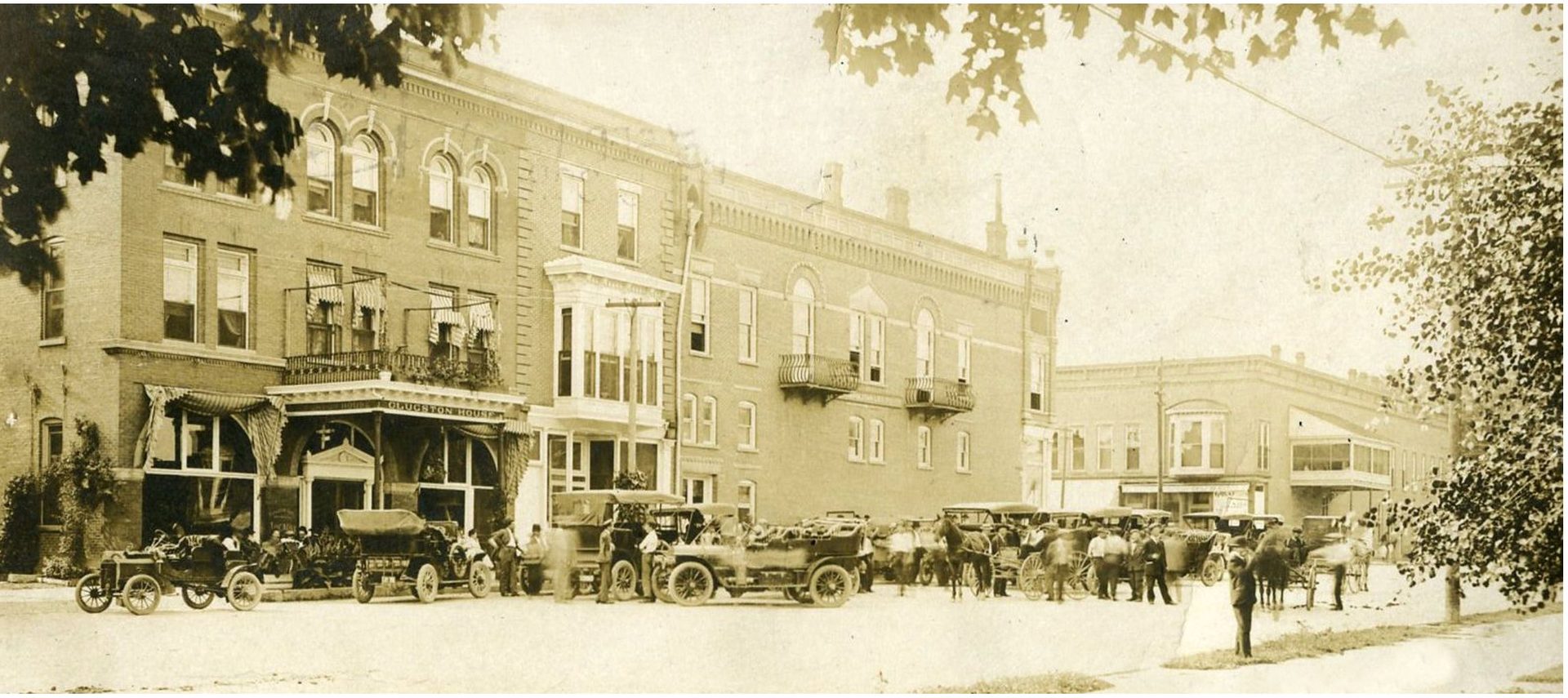
In late March of 1908, when Thomas Riley Marshall, a Democrat from Columbia City, became the party’s candidate for Governor, Baker officially introduced him before a bipartisan celebration at The Clugston Hotel in downtown Columbia City. Baker had been part of the reception’s planning committee along with his journalistic rival, W. W. Williamson.
In 1915, Baker retired from the Post Office and began work in the auctioneering business.
In 1917, Baker filed his intention to be a candidate for Mayor of Columbia City. He won his race, selected Logan Staples for his town marshal and one of his first major projects was the erection of a $10,000 monument for soldiers in World War I. Another notable event happened in 1918, with the approval of the Columbia City Common Council, when Baker hired Clarence Delagrange to be Columbia City’s first motorcycle policeman and armed him with an Indian motorcycle to conduct his work. In 1921, he filed for re-election to a second term and was challenged by Frank Meitzler. Meitzler won the election with 1053 votes ahead of Baker’s 921 votes.
Sarah Baker died at the age of 76 at 9 a.m. on December 2, 1921, from complications related to uterine cancer. She was buried in South Park Cemetery on the southern edge of Columbia City. After his wife’s death, he lived intermittently with his two daughters. Every year, he was known to return for Old Settlers Days when he would reconnect with old friends. He was an early founder of the annual festival.
In 1932, Baker was honored at the Indiana State Republican Convention as the oldest delegate. He had attended that same convention 62 years before.
At the age of 89, John W. Baker died Thursday, November 25, 1937, at 8 p.m. at the home of his daughter, Estelle Pontius, in Dayton, Ohio. A large funeral cortege brought his body from Ohio to Columbia City and he was buried in South Park Cemetery alongside his wife.
A $33,000 bond was issued in 1935 to fund the development of the park that would eventually be named in his honor, securing one of the last remaining large parcels of natural wooded land in the city and retaining it for public enjoyment. The park was initially 10 acres, but later expanded to cover an area of 40 acres. Much of the early work for the park was completed as part of the Work Projects Administration (WPA) which provided jobs for laborers during the Great Depression. The Baker Park Shelter House, razed more than 15 years ago, was a significant part of the WPA project.
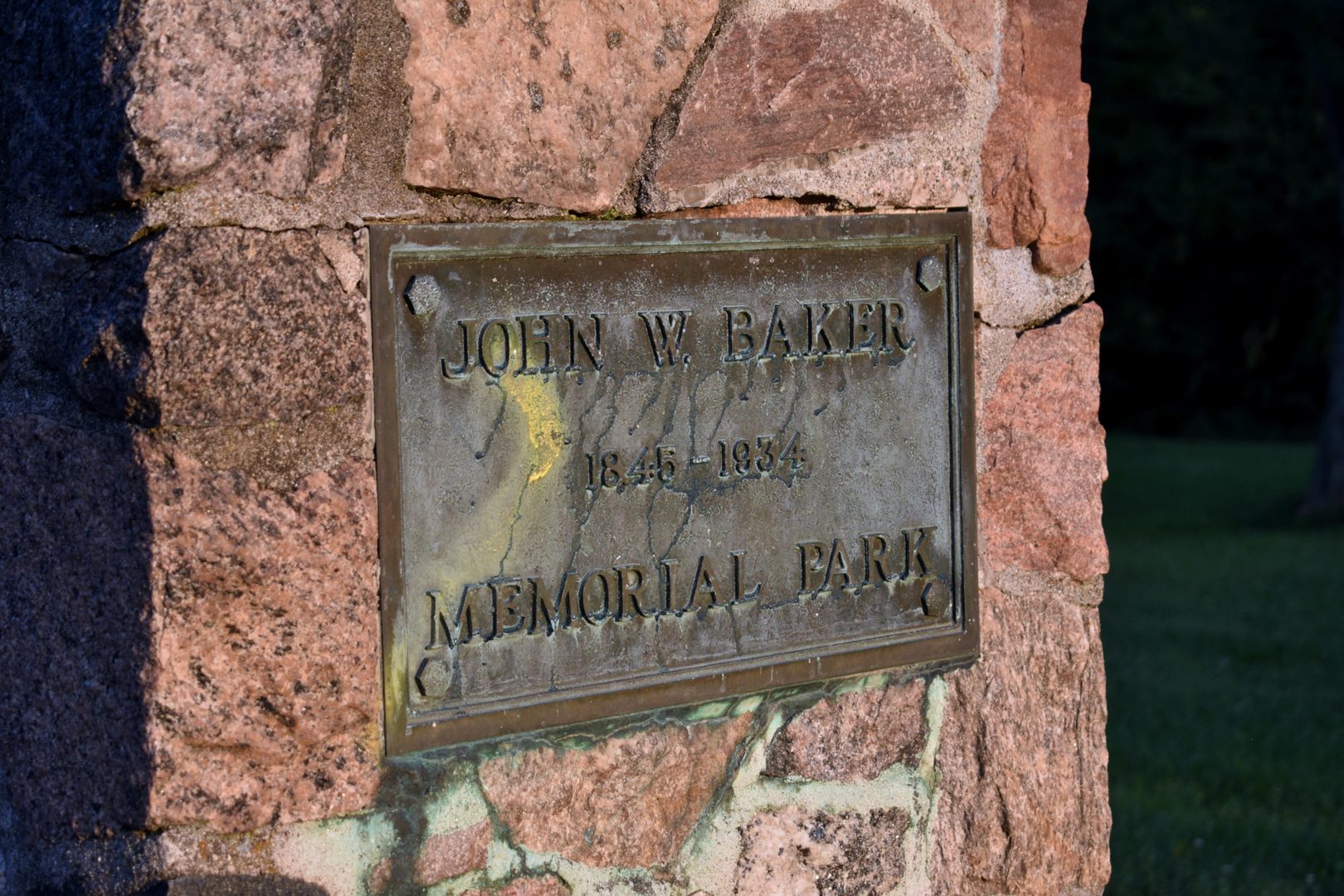
In the fall of 1939, during a Sunday afternoon ceremony, John W. Baker Memorial Park on the west side of Columbia City was officially dedicated. In addition to many friends and associates who attended the ceremony, several of his grandchildren and great grandchildren were there as well.
Thank you to Jennifer Romano, Whitley County Historian – Indiana for her outstanding research and writing of the article and the Whitley County Historical Museum for sharing photos from its collection.
𝑾𝒉𝒆𝒓𝒆 𝒂𝒓𝒆 𝑾𝒆: 𝑨𝒓𝒄𝒉𝒊𝒕𝒆𝒄𝒕𝒖𝒓𝒂𝒍 𝑯𝒊𝒔𝒕𝒐𝒓𝒚
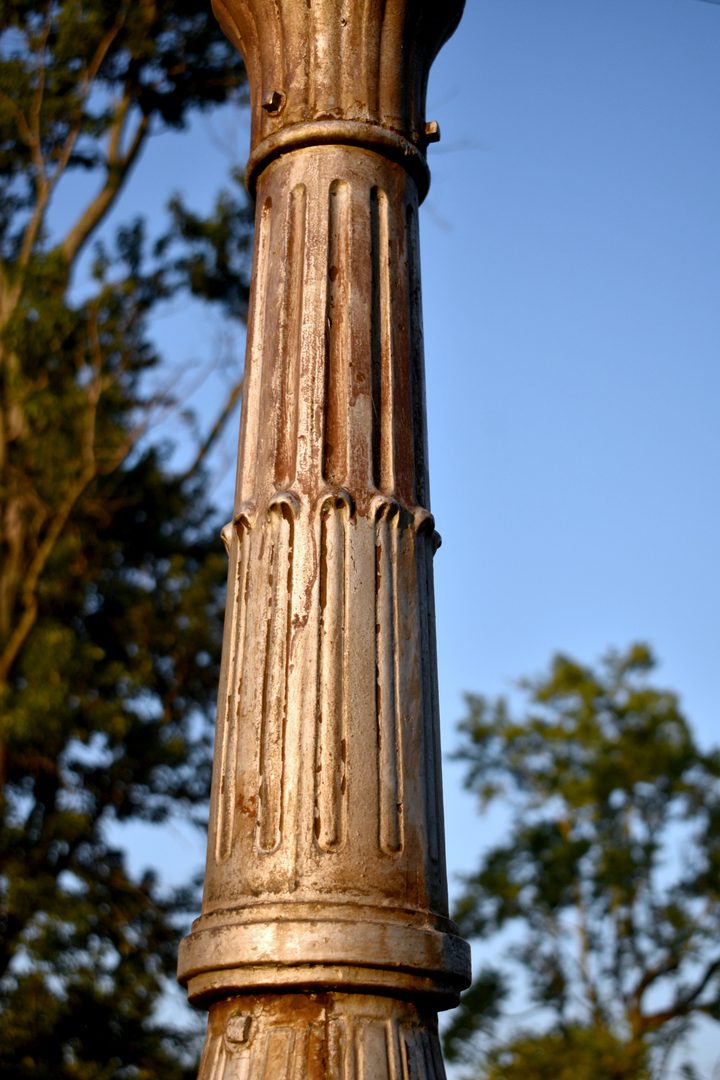
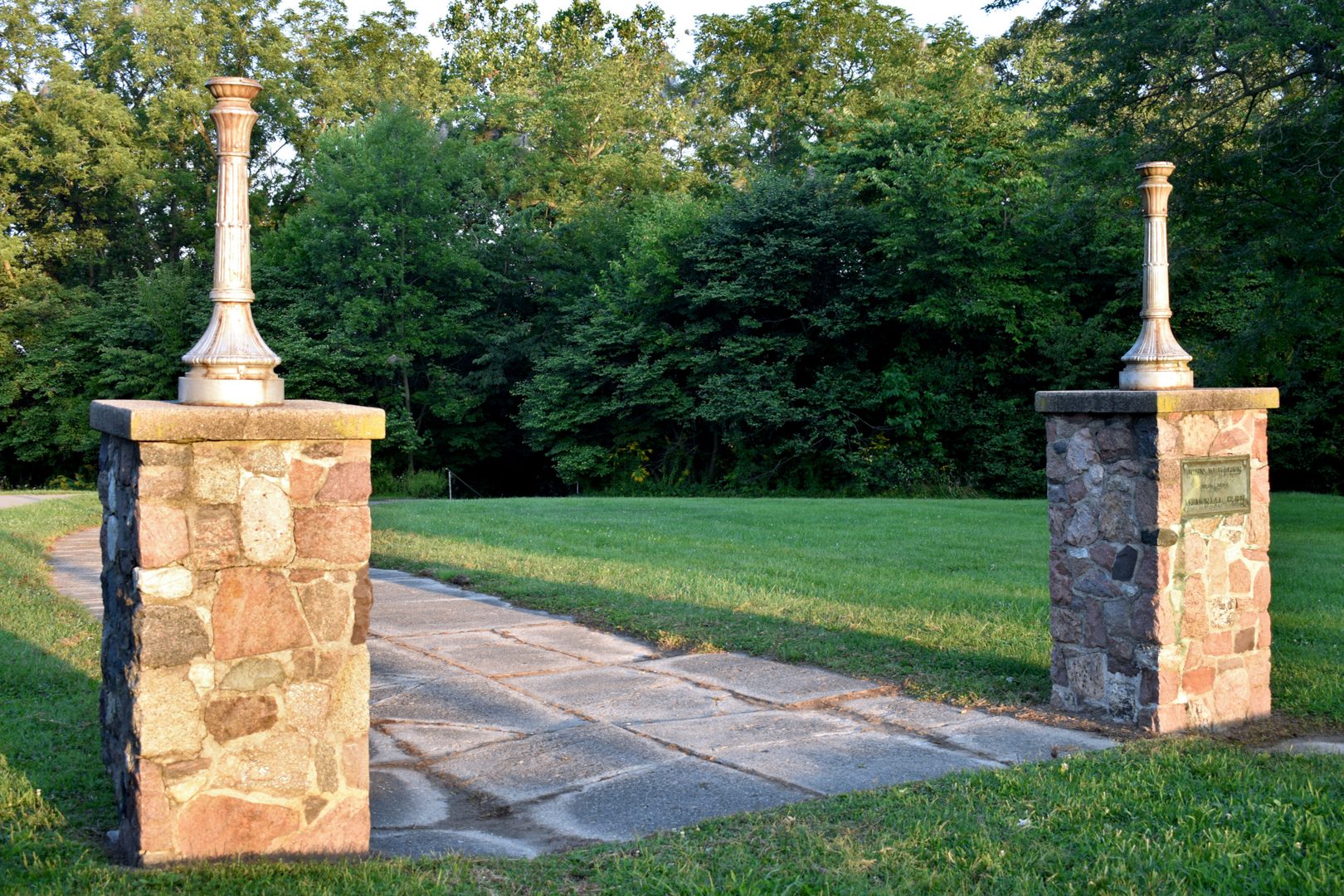
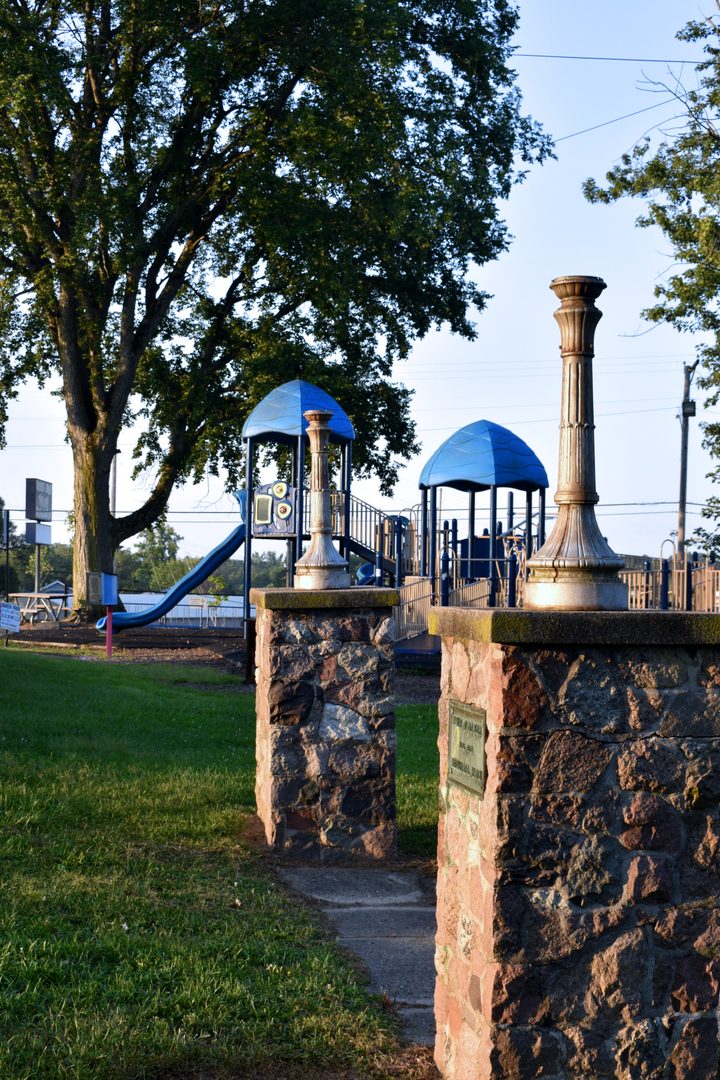
This column is hidden in plain sight in a popular yet unknown place. The column is one of a pair that marks the entrance to Baker Memorial Park at the west edge of downtown.
The metallic candlesticks set atop stone pillars and originally were topped with light fixtures. They formed the original formal park entrance along a broad walkway that stretched from McDonald Avenue down the stairs into the hollow at the heart of the park.
Most of the walk east of the columns is now gone, having been removed for a parking lot 30-some years ago. Now, Baker Park is mainly known as the home for Every Kid’s Dreamland.
Thank you to Nathan Bilger for providing the recent photos and valuable insights into the architectural history.